
A Journey of Courage, Connection, and Hope
Living with Familial FTD
Bradford Grems
Abstract
This personal journey highlights the importance of family, community, research, and resilience in living with familial FTD. From visits to the Mayo Clinic with my relatives to supporting my family through loss, I remain committed to raising awareness and contributing to research. Guided by love, faith, and hope, I strive to honor my family’s legacy and work toward a future where treatments and a cure are possible.
My dad, Keith, and I went to the Mayo Clinic for the first time in 2007. He passed away in 2009. I have been going to the Mayo Clinic every year since I started going with my dad. Several members of our family go to the Mayo Clinic at the same time every year so we can contribute to research and so we can be together to learn more about possible treatments that might come in the future. While my dad was living in a group home, he became unable to talk. My son was born in 2007, and my daughter was born in 2009. I would visit my dad frequently, and when I brought my kids with me, my dad would have the biggest smile ever and sometimes even cry because he was so happy to see his only grandchildren.
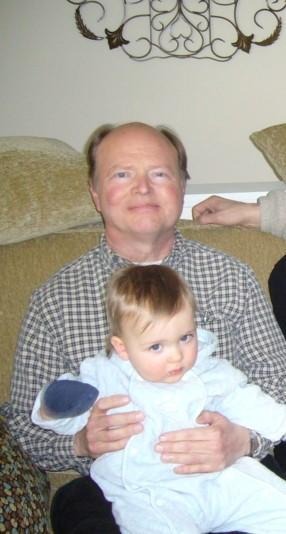
My dad and my son
After my younger brother, David, was diagnosed with FTD in 2022, my older brother and I helped him to get approved for disability from his employer and to move him out of the apartment he was living in by himself. We later decided to move him from California back to his home state of Michigan. Our family grew up in Michigan, and I still live there. We were originally planning to move him into a bedroom in the basement of my house. His ability to go up and down stairs had gotten so bad, we decided that he should not live in our house. We found a wonderful group home that was only a few miles away, and we moved him there. I would go see him every day. A lot of times, I would bike to the house, and then go for a walk with David, spend some time with him and the caregivers, and then bike home. It was great to have David back in Michigan as he could also see our mom and some of his friends from when he was a kid. Unfortunately, David’s FTD symptoms progressed very rapidly, and he passed away in 2024 at the age of 44.
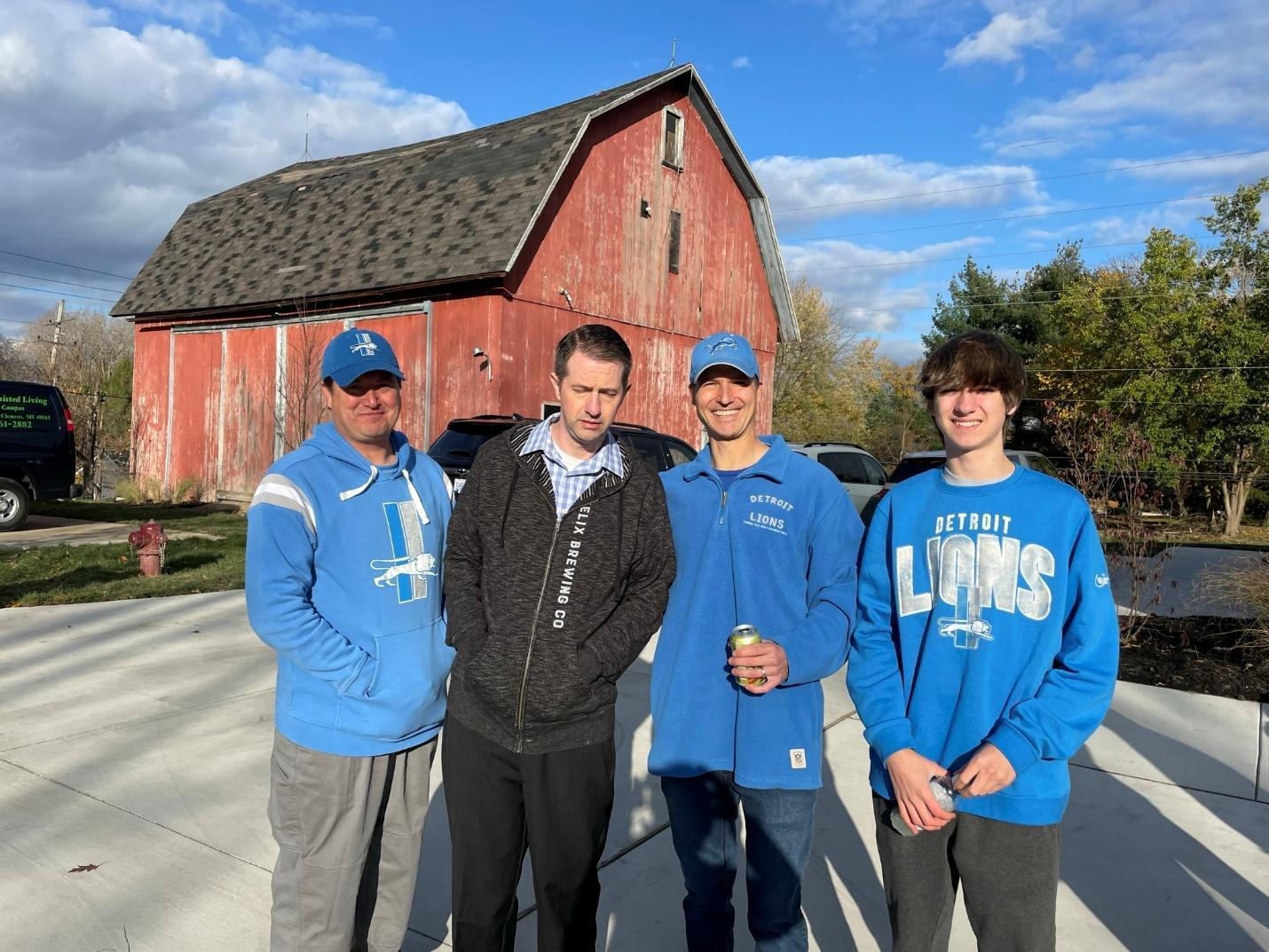
Me, my brothers and my son outside the group home where David lived in Michigan
Since I have been going to Mayo Clinic for so many years, I learned about genetic testing for family members who have a known genetic history of FTD. I actually got genetic counseling many years ago and decided to not learn my genetic status. When certain things in my life were not working as they did in the past, I decided to get genetic testing in late 2025. One of the big things in my life was that things were not going well at work. I was always a high performer at work but had about a year of not performing well and not able to manage and lead efforts. Learning about the genetic testing results was difficult, but it totally made sense that I have the MAPT gene that runs in my family. It made it easier to understand and explain why I was not doing things well that I used to do in the past.
My wife and I decided to tell our 18-year-old son and 16-year-old daughter about my diagnosis a few days after we received the results. It was a very difficult discussion, and both of my kids cried for a while. The first thing my son told me was that he wanted to join our family in the ALLFTD study at the Mayo Clinic. Now that he is an adult, he is eligible to participate, and it makes me incredibly happy that he wants to be involved in research to help find a cure.
My wife has been wonderful at helping take care of important things for me. She is fantastic at managing our household and family finances. Applying for disability through my employer went so fast and smoothly because she was so good at connecting with the right people.
I frequently reflect on my dad and his experience with FTD. He and I were diagnosed at about the same age. He was diagnosed at age 48, and I was diagnosed a couple of months before my 48th birthday. My dad always made exercise part of his daily routine. Even while he was living in the group home, he ran on a treadmill there until he was no longer physically able to. I follow in his footsteps and try to exercise every day. My wonderful neurologist at the Mayo Clinic, Dr. Bradley Boeve, emphasizes the phrase, “healthy heart, healthy brain”. I think about this frequently, as my father lived to the age of 60. That is more than 10 years longer than anyone else who has had FTD in our family including my aunt, grandfather, and great grandmother.
Before I knew that I carried the MAPT gene, I decided to participate in the UCSF study for families with neurodegenerative disease. This is a study for kids that are in families with genetic FTD. It was great to get my son and daughter involved in this and to spend time with them in San Francisco. My son was 16 and my daughter was 14 in the first year we participated in the study. It made me so happy that they got to experience similar testing that I have been involved in for so long.
My brain does not work like it did in the past, but I am so grateful that it still works well enough to do some of the things I love. I really love to drive, bike and bowl. My daughter even made a shirt for me a couple of years ago that has the words Biking, Bowling, and Cars on it as she knows I am passionate about all of that. I remember that several years after my dad was diagnosed, I had to take the car keys away from him as he was not safe to drive anymore. When that will happen for me, I do not know, but I told my wife to watch closely to make sure I am still safe to drive.
Bowling is something I started doing with my dad when I was a kid. He bowled in a league that was associated with our church. I joined his team when I was in high school, and I have been bowling ever since then. I was the head bowling coach at the middle school for my kids. It was such a pleasure to coach them, and I am very happy that I can still bowl well.
Considering that FTD is not a very well-known dementia, I am trying to be very open about my diagnosis. Regarding bowling, I decided to tell people in my bowling league about it. When I discussed my diagnosis with the president of the league, I told him that I want to be open about it and that it was OK for the whole league to know. We then planned a league meeting for everyone before bowling started one evening. During that meeting, I shared my diagnosis with the league and read the letter that Dr. Boeve wrote about my diagnosis. It was a deep meeting, and many members of the league got very emotional. At the end of the meeting, the league president led a prayer for me. It feels so good to have such great support from people in my life.
Speaking of great support from people in my life, I am also a member of a Men’s group at my church. We meet twice a month on Saturday mornings. The men in the group know about the genetic mutation in my family. When my brother, David, was originally diagnosed several years ago, I asked the group to pray for him. When we moved David to Michigan, I was able to bring him to the Men’s group once, and the men were so kind to him and prayed for him in person. At the first meeting after I got my diagnosis, I decided to share the results with the entire group. There were about 25 guys in the room for this meeting. After I shared my results with them, they immediately decided to pray for me. The group all gathered around me and a couple of guys led a deep prayer for me. If felt so good to have wonderful support from this great Men’s group.
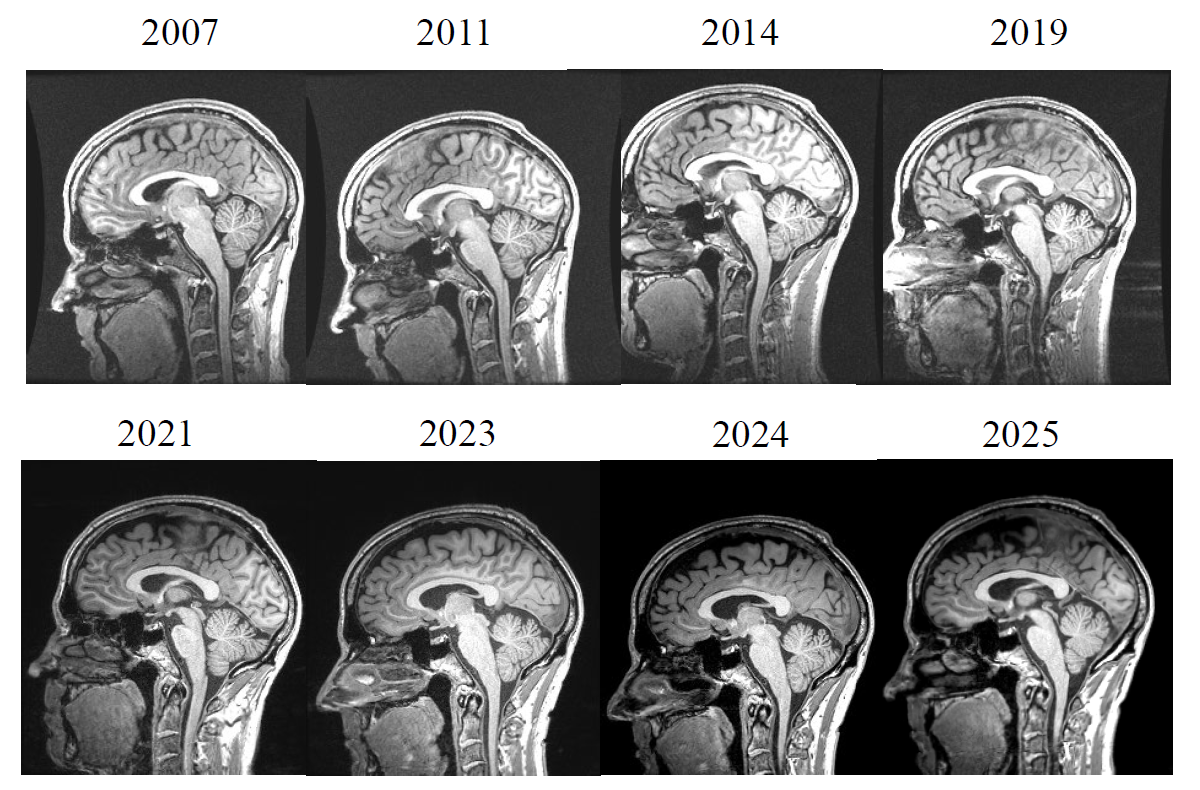
I think it is great that I can look at images of my brain going back to when I started going to Mayo Clinic in 2007. Reviewing the PET scans and MRI images is very helpful as things progress with me. I can see where things are starting to degrade and compare the images to those from my dad and my brother.
PET Scan Images of my Brain
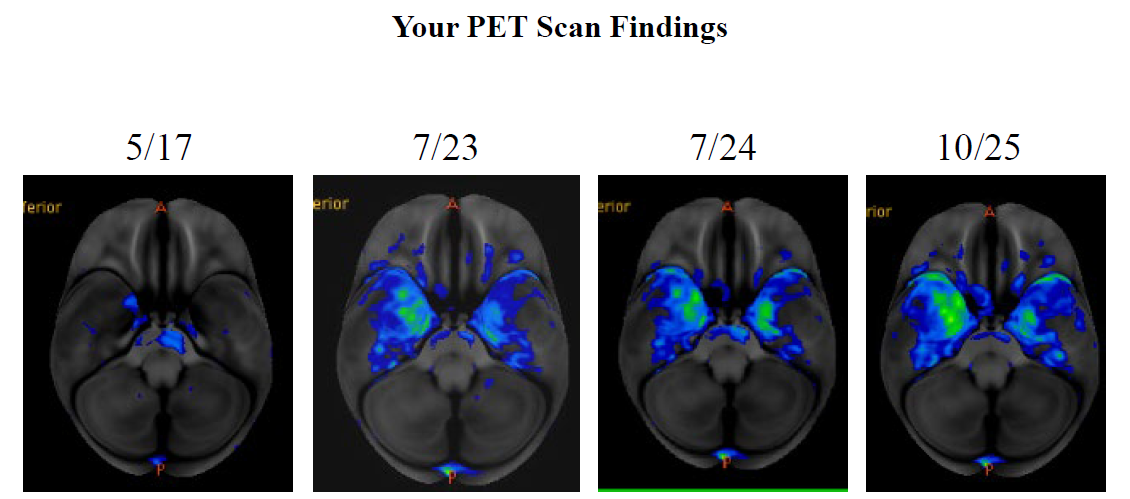
MRI Images of my Brain
Throughout my journey with FTD, I have come to realize the profound importance of my faith, family, community, and ongoing research. From the early days with my dad at the Mayo Clinic to the recent experiences with my own diagnosis, each step has reinforced my commitment to raising awareness, supporting research, and fostering connection. Sharing my story openly with loved ones and my community has not only provided me with strength but also inspired those around me to understand and provide support. I am deeply grateful for the incredible support from my wife, children, family, friends, my GM family and the medical and research teams that guide and accompany me. As I continue this path, I carry my dad’s legacy of resilience, hope, and love, trusting that together we can make a difference—pursuing treatments, raising awareness, and ultimately working toward a future where families affected by FTD find answers and a cure.
Bradford Grems
.png)
