

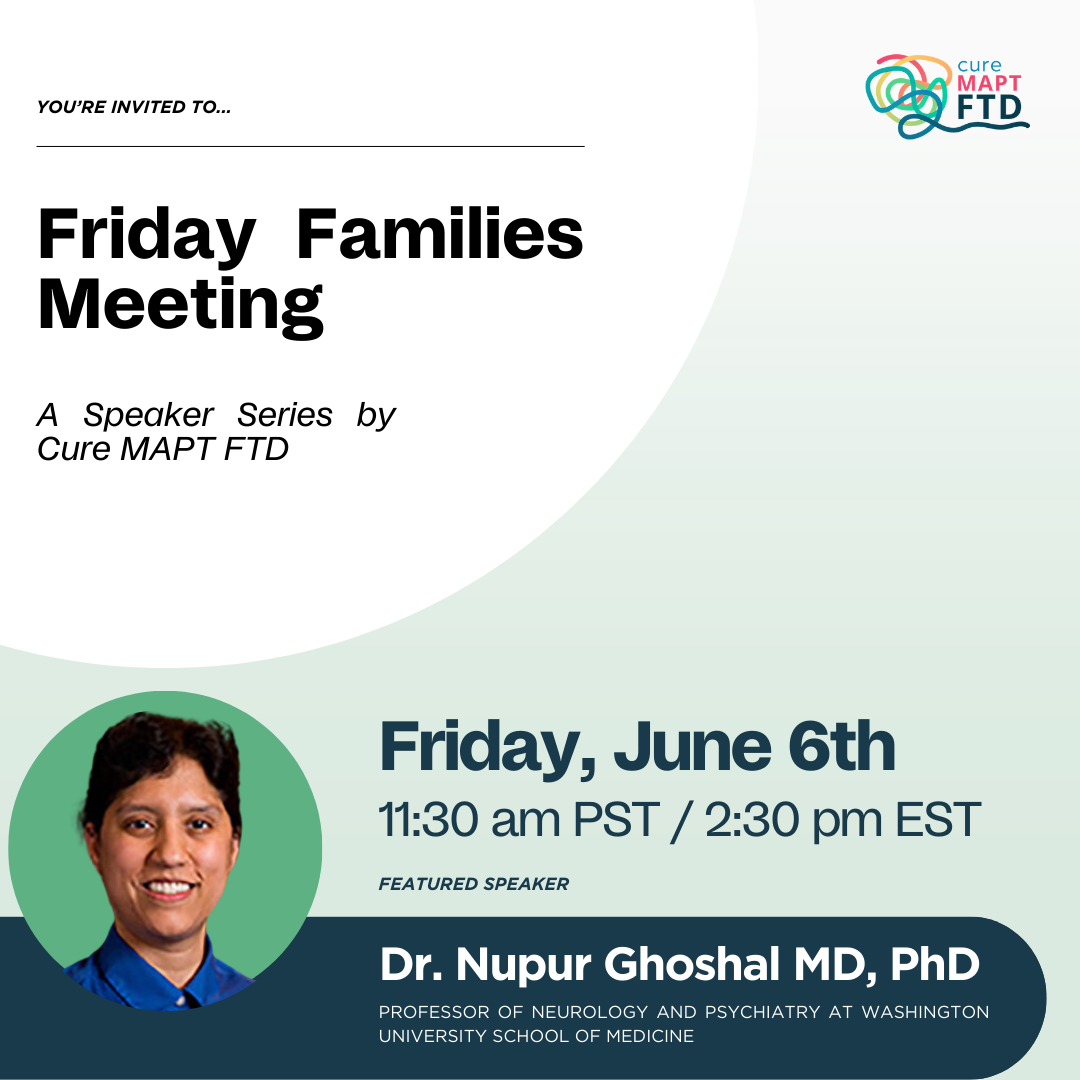
Come meet Dr. Nupur Ghoshal, Neurologist with Washington University School of Medicine in St. Louis, Missouri. She was one of the leads for the Human CNS Tau Kinetics in Tauopathies, aka TANGLES, which focused on the role of Tau in neurodegenerative diseases.
Join us so you can learn her thoughts on the latest exciting developments relevant to our community.
Send in your questions in advance. We will see you June 6th at 2:30 pm ET!
---
As readers know, our organization was one of the lucky few to have a Patient Listening Session with the FDA. During the 90-minute meeting, seven of our Cure MAPT FTD members spoke, detailing their loss of loved ones, and fear for their future. With eloquent, emotional words and photos, four asymptomatic positive mutation carriers and three care-partners spoke of the devastation incurred by this disease.
As 38 scientists and government officials listened, Dr. Bradley Boeve, one of our Scientific Advisory Board members, provided a disease overview and stressed the emotional toll it takes, even on attending physicians who treat these patients.
Supplied with our community survey feedback, we made the following requests to the FDA:
Our hope is threefold: That the FDA will accede to our wishes; that scientists will push as far and as fast now that there are so many new technologies available such as gene therapies, gene editing and ASO technologies; and that pharmaceutical companies will embrace their win-win: enlarging their potential market with an expanded patient population while, most importantly, saving precious and countless lives around the globe .
Next steps? We are producing an Executive Summary, documenting the session, for the FDA to review. We will then post it on our website and the FDA will link to it on their site, as a public record.
Thank you to all of you for your candor and support in our FDA Listening Session.
---
As FTD families, we all know the almost unbearable financial cost this disease enacts. To help ease some of the burden, there is a new bipartisan bill that has been introduced, The Credit for Caring Act of 2025. Available only to US citizens, this would be a “non-refundable federal tax credit of up to $5,000 for eligible family caregivers with an earned income of at least $7,500 for the taxable year,” writes The Association for Frontotemporal Degeneration. Please sign on with your support, via the AFTD’s simple tool.
Newsletter subscribers know some Cure MAPT FTD members attended the Global Tau Conference in April. Both the Alz Forum and Cure PSP provide good overviews of the conference, from trial news to how Cure MAPT FTD’s Linde Jacobs and two affected individuals from PSP spoke about life with these diseases. “Their presentations moved the audience, who by and large don’t get to interact with patients, and drove home the urgency of finding treatments for rare diseases,” noted the Alz Forum. Meantime, an expansive overview of last year’s conference, with Linde cited as an author, appears in Alz Journals.
---
In Nature, a scientific brief looks at multiple vaccines being tested in mouse models that would provide antibodies to reduce phosphorylated Tau. One of them “induced robust antibody responses, cleared pathological tau, and rescued memory deficits in a transgenic mouse model of tauopathy.”
Meantime, Nuravax has been awarded $3 million from the NIH, for Duvax, the first dual-target Alzheimer's vaccine. "Based on strong preclinical data, we at IMM expect
Duvax to elicit a robust immune response against both Aβ and tau pathologies," said Dr. Michael Agadjanyan, VP of IMM and Head of Immunology.
Regeneration Biomedical announced that it is using stem cells from nine Alzheimer’s patients at Hoag Memorial Hospital Presbyterian in Newport Beach, CA, and is injecting them directly into the brain “to stimulate the activation and maintenance of stem cells in regenerative regions of the brain while reducing inflammation,” according to a report in Genetic Engineering & Biotechnology News.
In this Phase 1 trial, 80% of patients had reduced phosphorylated p-tau levels. “We are actively exploring next steps, including a Phase II trial, and see potential opportunities to investigate this approach in other neurodegenerative diseases in the future, pending further data and regulatory guidance,” said the company, which is now exploring a Phase II trial. We will be contacting them to learn more.
Using ALLFTD’s cerebral spinal fluid from 116 genetic carriers and 39 non-carrier members, researchers at The University of California San Francisco, including our own Scientific Advisory Board, Dr. Adam Boxer, found there were “molecular signatures that could transform how this often-misdiagnosed condition is detected and monitored.” For MAPT specifically, there were extracellular matrix changes. In presymptomatic carriers of both C9orf72 and MAPT mutations, they found decreased levels of proteins responsible for ion transport, “suggesting neural signaling changes might occur before widespread brain degeneration.” As the article in Science Blog notes, while research focuses on targeted therapies, “the protein signatures identified in this study may not only help identify patients earlier but also monitor treatment effectiveness in clinical trials.”
Finally, in potentially good news for everyone, Tau Consortium member Dr. David Holtzman of Washington University School of Medicine in St. Louis, studied lemborexant, a sleeping aid marketed as Dayvigo. The study shows that this aid may not only help with the symptoms of neurodegeneration but may actually reduce the build-up of Tau. While this is a preliminary study done using a mouse model; it seems to work much more effectively in male mice; and sleep aid studies have not been tried on FTD patients; we do know that Tau build-up and insomnia both cause inflammation, so this is a study worth watching.
---
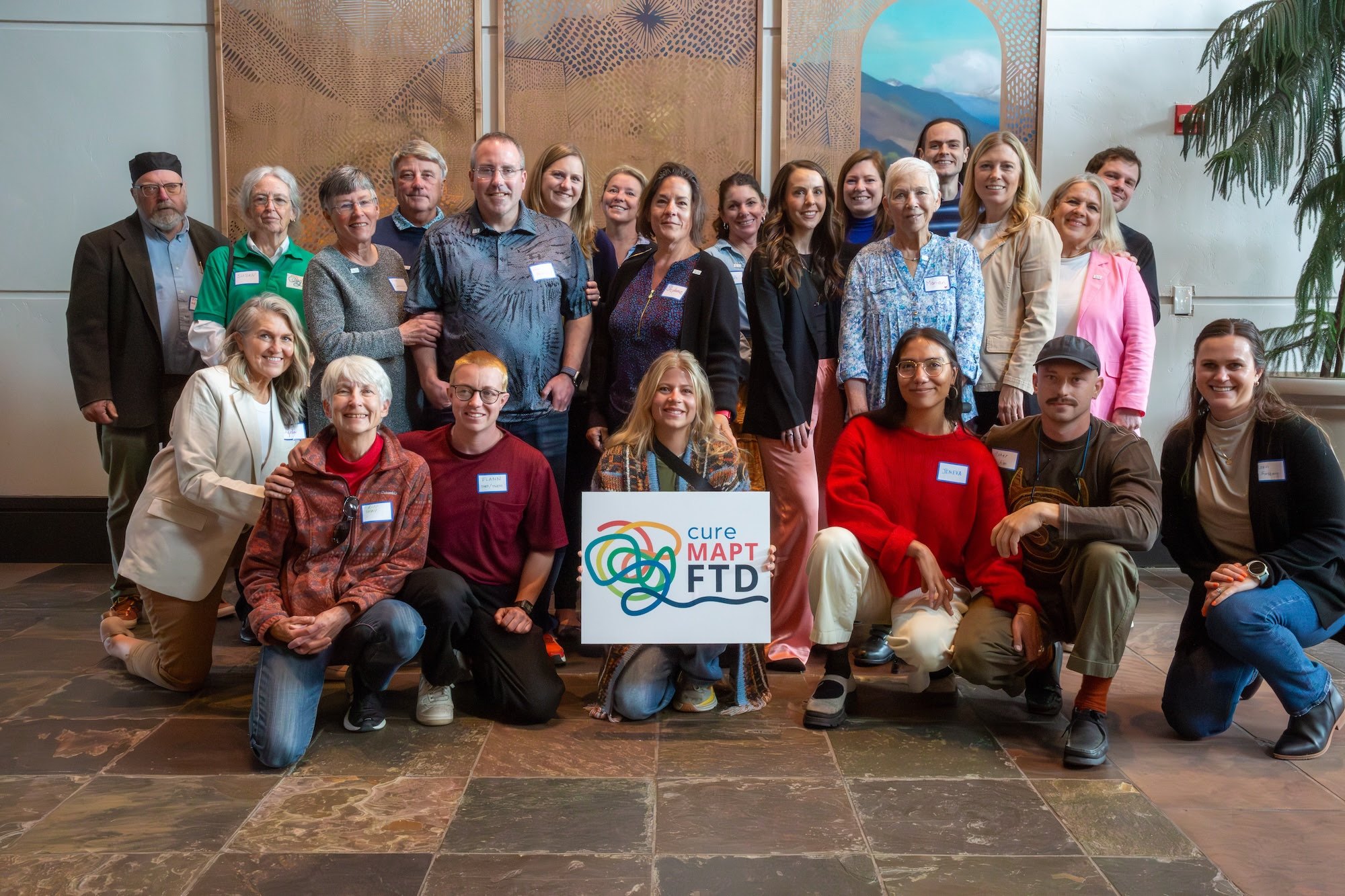
On May 1 and 2, 2025, the AFTD held its annual Educational Conference in Colorado, where participants were able to connect with other families, learn about resources and support and engage with FTD experts.
For the first time, a genetic symposium was held for families who are impacted by familial FTD; Linde Jacobs participated in a genetic perspectives panel with other genetic advocates and a genetic FTD overview was provided with updates on the therapeutic landscape for GRN clinical trials. The second day featured keynote speaker Katie Brandt who gave a moving account of her personal journey with FTD as a dementia care-partner and inspiring ways she turned her experience into advocacy and support. The day also featured a moving lived experience panel, with participants sharing their experiences of living with FTD and how they find meaning and purpose. Other notable speakers included an impassioned advocacy plea from the remarkable Emma Hemming Willis, who underscored the importance of fighting for a cure for FTD - she had everyone on their feet by the end of her talk!
For us, the other highlight was the strong presence of Cure MAPT FTD families at the conference, seeing old friends and meeting new ones! The Cure MAPT FTD sponsor table included resources, an interactive photo display, our most recent research poster, and some giveaways for the many friends who dropped by to say hello, including new MAPT families. Everyone enjoyed the delicious welcome breakfast, made meaningful connections and strengthened our resolve to keep fighting for our families and a cure for MAPT FTD!
Special thanks to Barbara Frommell for her warm welcome to her beautiful state of Colorado.
Next year, the AFTD Educational conference will take place in Seattle, Washington on April 30th- May 1st 2026.


.png)